eesti
english
Contact
|
Publishing
|
Services
|
Doctoral theses
|
OA
|
FAQ
|
Partners
|
History
Search
Advanced search
Shopping Basket
Journals
Book Series
Art History
Culture Studies
Economics
Folklore
History and Archaeology
Language and Literature
Law
Media
Mathematics
Medicine
Natural Science
Philosophy
Physical Culture
Political Studies and Sociology
Semiotics
Theology and Religious Studies
Doctoral Theses
Tweet
Natural Science
Please note that books on natural science published in Estonian are only included in the
Estonian version
of the web shop.
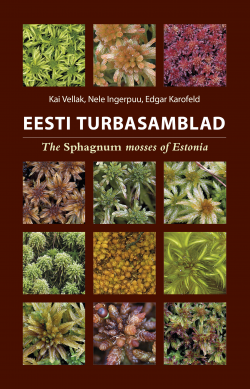
Eesti turbasamblad. The Sphagnum Mosses of Estonia
Author
Kai Vellak, Nele Ingerpuu, Edgar Karofeld
Language
Estonian, English
Publisher
SOLD OUT
Year
2013
Pages
136 p.
Format
155x235 mm.
ISBN
ISBN 978-9949-32-309-8
Price
12,00 €
The book is posted after the payment is made.
More details click
here
Annotate
Sphagnum mosses are widely distributed and common throughout most of the world. These mosses play a leading role in peat formation and can even alter landscapes by acting in mire formation and development. People have long used Sphagnum mosses for their everyday necessities and therefore these mosses are rather well known at the genus level. It is nonetheless also important to recognize the species. Species identification enables us to evaluate the state of mire and forest communities, and to make sound decisions to protect different sites and species. Sphagnological studies in Estonia started already in the 19th century by Edmund A. F. Russow and Gustav C. Girgensohn, who both worked in Tartu. They described eight previously unidentified Sphagnum species on the basis of specimens collected from Estonia. The first guide book of Sphagnum mosses of Estonia by Laasimer et al. (1954) was published more than fifty years ago. As this book is long out-of-print, and the taxonomy and even species composition in Estonia has since changed, the need has arisen for a new book on local Sphagnum. With this book we would like to give an overview on the distribution, growth habitats, anatomy, ecology, use, and nature protection of peat mosses in Estonia. However, our primary aim is to encourage and help you to recognize species in field conditions with the help of original photographs, drawings and descriptions, or at home with a microscope. Therefore the book is supplemented with two keys, one providing field-characters and the other microscopic characters. The keys, short descriptions of species and figure titles are also given in English. Thus the book can be used in neighbouring countries as well, since all 38 Sphagnum species included in this book are widely distributed in mires and forests in the temperate zone. Distribution maps presented in this book are based on specimen data maintained at the Estonian herbaria. They give an overview of the species frequencies in all fifteen Estonian counties. With the help of this book we hope to lead you to the amazing world of Sphagnum mosses – maybe all similar at first glance, but each quite attractively unique upon a closer look. This book can be of help to natural scientists, students, nature conservation specialists, and all friends of nature.
Info and service
How to buy
NB! Important information
Contact
|
Publishing
|
Services
|
Doctoral theses
|
OA
|
FAQ
|
Partners
|
History
Copyright © Tartu ?likooli Kirjastus 2026 Ülikooli 18, 50090 Tartu, tyk@ut.ee, 737 5945